Why 2025 Was a Year of Both Growth and Growing Pains
Digital marketing in 2025 was marked by transformation. AI tools and agents moved from experimental to everyday use. Paid media costs continued to rise, forcing brands to balance scaling with efficiency. Search evolved as Google’s SGE (Search Generative Experience) began to shift how results are delivered. Conversion optimization moved further to the center of the conversation, with brands realizing that clicks without conversions no longer cut it.
For CMOs, digital marketing directors, and analytics leaders, the year was one of both breakthroughs and wake-up calls. Some brands achieved record growth by aligning strategy with business outcomes. Others discovered that chasing trends without discipline left them with high costs and limited ROI.
Looking back at 2025, there are clear wins — and equally important lessons to carry forward.
Paid Media Win: Efficiency Beats Spend
One of the most important shifts of 2025 was the move from scaling budgets at all costs to focusing on efficiency. Brands that thrived didn’t just pour more money into Google or Meta. Using AI to help analyze results quicker and gain deeper insights, they restructured accounts, doubled down on profitable segments, and demanded accountability from every campaign dollar.
Case Study: FilterBuy
FilterBuy, a direct-to-consumer air filter retailer, faced exactly this challenge. Rising CPCs and reliance on blind automation were squeezing profitability. Working with (un)Common Logic and through methodical gradual testing, FilterBuy restructured its campaigns, cut wasted spend, and reinvested in high-performing segments.
The results were dramatic: a 758% increase in profitability QoQ, steady order volume despite reducing spend by 40%, and a 176% lift in ROAS.
The lesson: scaling is important, but scaling responsibly — with efficiency and control — drives real profit growth.
SEO Win: Content Structuring for Visibility
2025 saw SEO evolve beyond keywords into authority-building. With SGE rolling out, Google rewarded sites with clear topical clusters, structured data, and fresh, helpful content. SEO didn't die. It evolves. What remains true is this: Platforms reward quality content that they can easily understand and decipher.
Case Study: ACV Auctions
Though a B2B marketplace, ACV Auctions provides a powerful SEO example. The company needed greater visibility for high-value terms. (un)Common Logic optimized over 200 pages, restructured site content into topical clusters, and emphasized schema for crawlability.
The outcome: a 278% increase in page-one keyword rankings and a 92% increase in registrations year over year.
The lesson: in an era of AI-driven search, SEO is no longer about chasing isolated keywords. It’s about building authority and trust signals across structured, interconnected content.
CRO Win: Testing That Transforms
Conversion rate optimization shifted from “nice-to-have” to business-critical in 2025. As paid media costs rose, maximizing revenue per visit became essential. More critically, the increase in AI answers vs. listings has resulted in a decrease in site traffic all-around making site traffic incredibly precious to convert. Brands that invested in structured CRO programs saw exponential gains and increase in conversions. Those that didn't saw a decrease in conversions and an increase in cost per conversion.
Case Study: Blue Apron
Blue Apron, the meal kit subscription brand, faced slowing conversions despite strong traffic. Working with (un)Common Logic, the team tested new landing page designs, experimented with offer framing, and simplified navigation.
The result was a 187% increase in conversions and an 86% lift in conversion rate.
The lesson: CRO isn’t a supporting tactic. It’s a primary growth lever that determines whether traffic translates into revenue.
Analytics Win: Marketing Data as a Business Asset
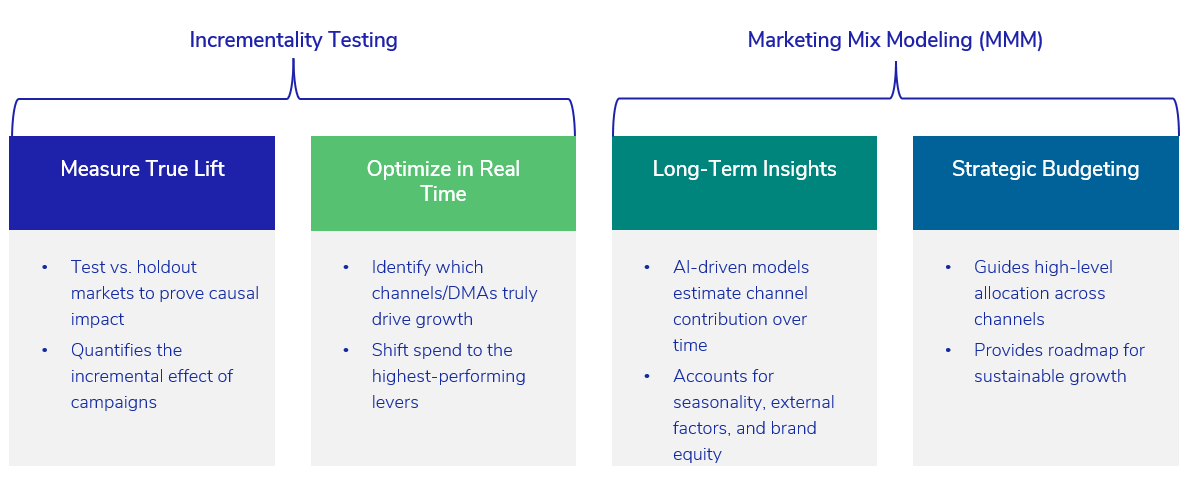
2025 also saw data-driven decision-making mature. With privacy changes and fragmented channels, brands leaned into unified analytics to understand attribution and pipeline impact. But unified doesn't mean one platform. Successful brands learned there is no singular tool or platform that can provide every answer the business is asking. Instead, there needs to be a combination and blend of views to analyze the data to make the right decisions (e.g. MMM vs. Incrementality Testing). Each type achieves a different goal.
Case Study: All Covered
All Covered, Konica Minolta’s IT services division, wanted to better connect marketing activities to conversion outcomes. By adding social proof, streamlining forms, and personalizing nurture flows, they increased form submissions by 200% and improved conversion rates by 54%.
The lesson: analytics and optimization aren’t separate functions. Data-driven insights, tied to trust-building, transform not just lead volume but lead quality.
Lessons Learned in 2025
2025 showed that growth is possible even in a challenging environment — but only for brands that lead with strategy, discipline, and customer-centricity.
-
AI accelerates workflows, but human oversight ensures content resonates.
-
Paid media must be scaled with efficiency controls, not unchecked budgets on automated campaigns without control.
-
SEO wins come from authority and structure, not keyword chasing.
-
CRO is the multiplier that makes every click worth more.
-
Analytics, when connected to business outcomes, builds trust across leadership teams.
What to Carry Into 2026
Looking forward, 2026 will only amplify these lessons. AI will become even more integrated into tools and workflows, making authenticity and differentiation more critical. Remember that any tool is only as good as the data feeding it and the rules and guidelines set to teach its learning.
Paid media costs are unlikely to decline, keeping CRO and efficiency front and center. Ads production will grow exponentially as brands lean into AI. Quality of ads will be the biggest differentiator between competitors. Organic search and organic traffic will continue to evolve, rewarding brands that prioritize authority.
For marketing leaders, the mandate is clear: integrate channels, align with business outcomes, and focus on quality over quantity.
At (un)Common Logic, we help brands make sense of these challenges — and turn them into growth opportunities. Contact us to see how we translate insights into uncommon results.
FAQs
What was the biggest win of 2025 for digital marketing?
Brands that focused on efficiency over scale saw the strongest ROI, particularly in paid media and CRO.
How did AI impact marketing in 2025?
AI became mainstream for content creation and workflow automation, but success depended on human oversight for voice and authenticity.
What should CMOs prioritize for 2026?
Integration across channels, investment in CRO, and building authority in SEO.
What’s the biggest risk going into 2026?
Chasing tools or trends without aligning them to business outcomes.