How Missing Hreflang Sent International Shoppers to the Wrong Regional Ecommerce Site.
International SEO has a reputation for being intimidating, and hreflang is often one of the main reasons why.
Hreflang is technical markup that helps search engines understand which version of a page is intended for a specific language or region. The underlying idea is simple: when a brand operates multiple websites for different markets, it needs to clearly explain the relationship between those pages. Without those signals, Google may select the wrong regional version. Here is how that problem appeared for one global ecommerce brand and what a proper solution required.
The Situation: Multi-Region Ecommerce Sites Without a Working Hreflang Setup
The brand operated separate ecommerce sites for the United States, Australia, and a broader global audience.
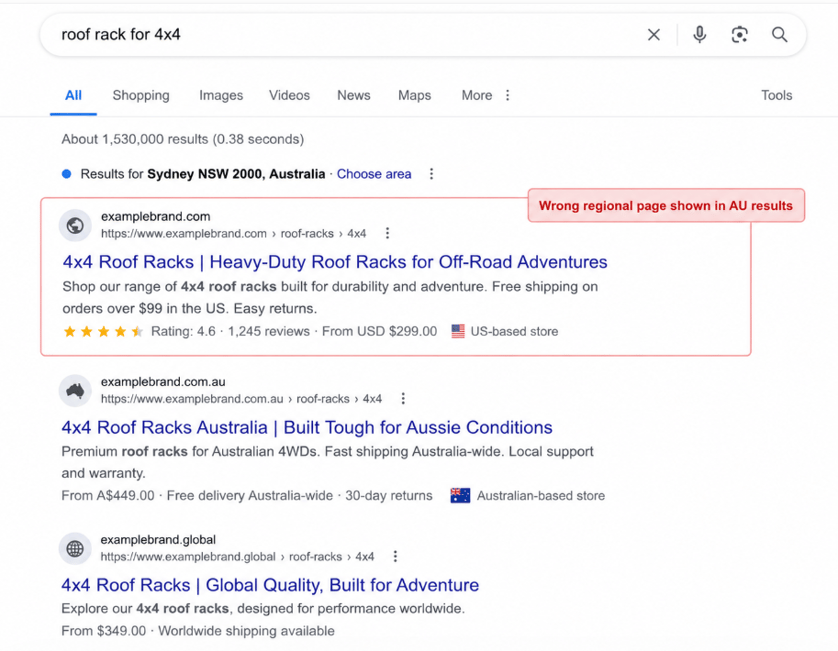
Many of the sites featured similar products and content, but pricing, product availability, shipping options, and market relevance could differ. During the SEO review, we found that regional pages were appearing in the wrong markets. In some cases, pages intended for one country were ranking for users in another. That created a disconnect between the search result and the experience after the click. A user could land on a page with the wrong currency, pricing, product availability, or shipping information. Even when the product itself was relevant, the regional experience was not.
Why This International SEO Problem Was Easy to Miss
This type of issue can hide in plain sight.
At a brand level, overall rankings and traffic may appear healthy. The company may still rank for its core products and categories. The problem becomes clearer only when performance is reviewed by country and domain.A keyword may appear to rank well overall, while the wrong regional domain is actually earning the visibility. That can make international SEO performance look stronger than it really is.It can also cause multiple regional websites to compete for the same searches rather than allowing one clear, relevant page to serve each market.
What Made the Hreflang Implementation Difficult
Several technical factors were creating mixed signals.
Similar Content Across Regional Ecommerce Sites
The websites carried many of the same products and used largely similar content.
That is normal for an international brand, but it makes it harder for Google to determine which version should appear in each market without clear regional signals.
Missing or Incomplete Hreflang Tags
The relationship between equivalent regional pages was not being communicated consistently.
Without a reliable hreflang setup, Google had to determine the intended audience of each page using other, less direct signals.
Geolocation Redirects Are Not a Substitute for Hreflang
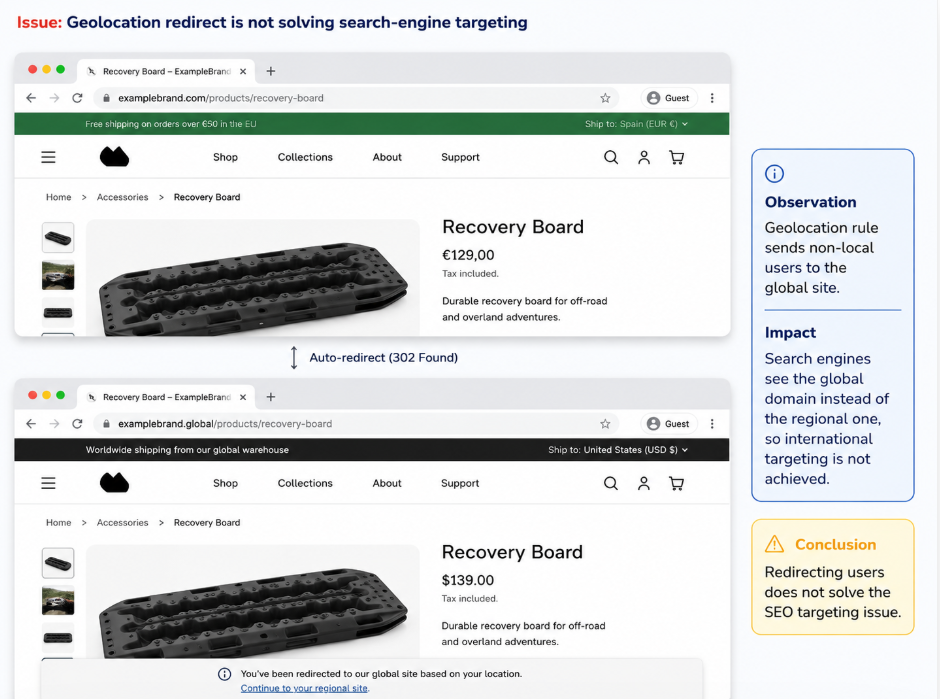
A Shopify geolocation app was redirecting many non-Australian visitors to the global website.
However, geolocation redirects and hreflang solve different problems. A redirect acts after someone or something reaches the site. Hreflang helps Google choose the appropriate URL before the user clicks the search result. The redirect therefore did not resolve the underlying search-engine targeting issue. It could also create problems for users and crawlers by forcing traffic to a general global version rather than allowing the appropriate regional page to be selected.
Hreflang for Products That Don't Exist in Every Market
Some products were available in certain countries but not others.
That meant the implementation could not rely on one identical template for every URL.Each hreflang set had to include only the corresponding pages that actually existed.
The Fix: Building a Correct Hreflang Structure Across Regional Sites
The solution was to build a clear hreflang structure connecting equivalent pages across the regional sites.
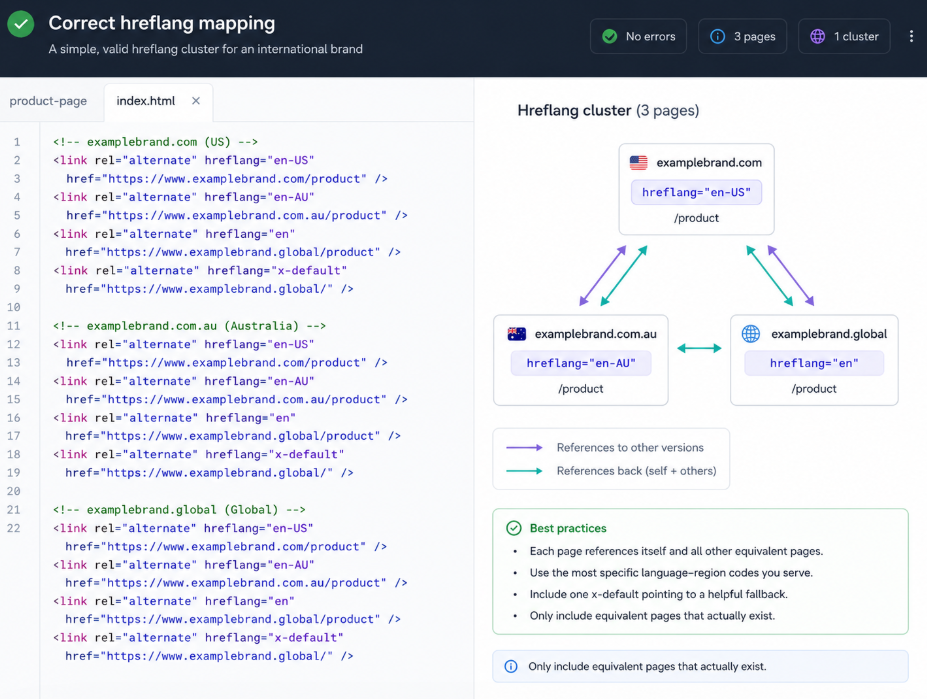 For pages available in all markets, the implementation could include:
en-US for the United Statesen-AU for Australiaen for the general English versionx-default as the fallback version
Each page also needed to reference itself. For example, a US page should identify itself as the US version while also referencing the matching Australian and global pages.Those references must be reciprocal. If the US page points to the Australian page, the Australian page must also point back to the US page. Consistency is essential, but that does not mean every hreflang set must contain the same number of URLs. When a product exists only in the US and Australia, those two pages can reference each other without including a nonexistent global version. A valid partial set is better than linking to an irrelevant page or a URL that does not exist. The geolocation setup also needed to be reconsidered so that it did not override or conflict with the regional signals being provided to search engines.
Expected Impact of Fixing International Hreflang Signals
Hreflang is not a direct ranking boost.
Its purpose is to help Google show the right version of a page to the right user. A correct implementation should help:
- US users find the US website
- Australian users find the Australian website
- Other users reach the appropriate global version
- Regional sites avoid unnecessary competition with one another
- Users see more relevant pricing, products, and shipping information
- SEO teams evaluate international performance more accurately
These changes require time to be processed. Search engines need to recrawl the affected pages, recognize the updated relationships, and adjust which URLs they serve in each market.
The Takeaway: Hreflang Is the Foundation of International Ecommerce SEO
Launching multiple regional websites does not automatically create a successful international SEO strategy.
Without clear signals, those websites can compete with one another, rank in the wrong markets, and send users to pages that do not match their location. Hreflang helps search engines understand how regional pages relate to each other and which version is most appropriate for each audience. It may not be the most visible part of an international website, but it can be the difference between a global presence that supports each market and one that quietly works against itself.